⚠️ It is recommended not to use Lossless Scaling during this test
Once the test starts:
You can close the Game Bar
Continue playing normally
AutoPilot analyzes real gameplay performance in the background while you play.
Performance analysis
During the test, an overlay will appear showing:
“AutoPilot is analyzing performance…”
Along with a progress percentage.
When the test finishes, you’ll see:
“Performance capture complete. Open Smart Profiles widget to continue.”
Review and submit
Reopen the Smart Profiles widget.
Review your AutoPilot Rating and performance data before submitting your report.
You’ll see:
The AutoPilot Rating for your device
To finish:
Press Submit Report
What happens next?
Your report will include your performance data and AutoPilot Rating, helping other players with similar devices understand how well a profile performs.
Want to share your own profile with the community?
Browse recommended and community Smart Profiles and instantly apply optimized settings for your game.
3. AutoPilot Rating (The Key Piece)
Sharing settings is useful.
But knowing which settings are actually good is what really matters.
That’s where AutoPilot Rating comes in.
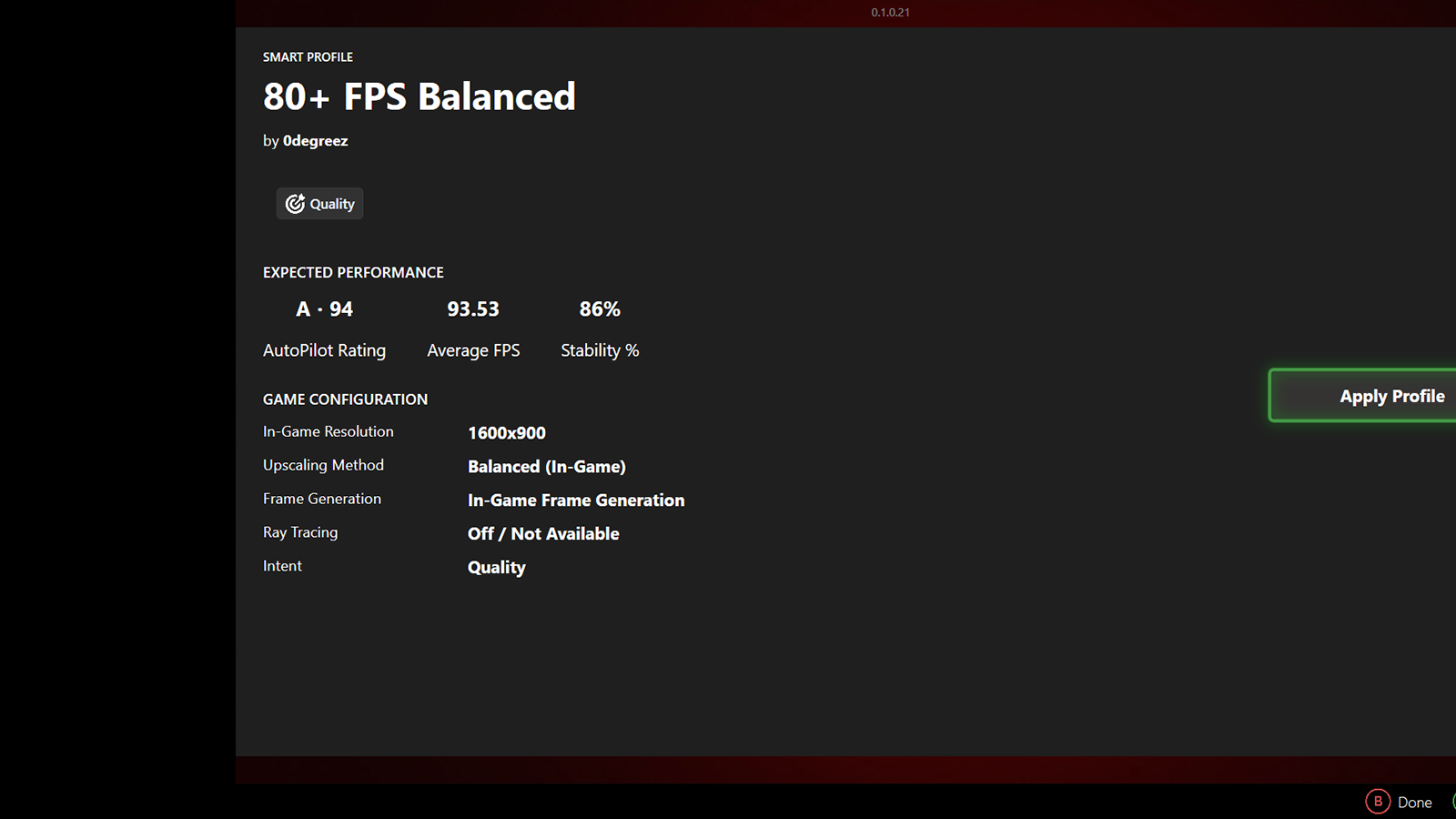
Example of a Smart Profile with AutoPilot Rating, showing real performance data including FPS and stability.
What it measures
AutoPilot Rating is based on real performance data, including:
Average FPS
Stability (%)
1% low FPS
This isn’t guesswork or opinion-based.
It’s data-driven evaluation
How the rating is calculated
AutoPilot Rating combines two key factors:
Performance → how fast the game runs (FPS)
Stability → how smooth and consistent the experience feels
Performance measures how fast the game runs, based on average FPS. Stability evaluates how smooth and consistent the experience feels, taking into account frame pacing, stutter, and 1% lows.
These values are combined into a single score that represents the overall gameplay experience, where:
Performance defines the baseline
Stability adjusts the result based on how smooth the experience is
Understanding the rating
The final result is presented as a letter grade, making it easy to understand at a glance:
A → Very smooth experience
B → Good, with minor inconsistencies
C → Playable, but noticeable drops or instability
D → Poor performance, not recommended
What a good score means
A higher AutoPilot Rating generally means:
More stable gameplay
Better frame consistency
A smoother overall experience
It helps you quickly understand:
“Will this actually run well on my device?”
Device-aware ratings
AutoPilot Rating is not universal across all devices.
It is calculated using performance data from devices similar to yours.
This means:
A profile may have a different rating on a Steam Deck vs a ROG Ally
Ratings are more relevant to your specific hardware class
You’re not seeing generic scores, you’re seeing results that actually apply to your device.
How it helps you choose
Instead of:
Guessing between multiple configs
Watching long comparison videos
You can:
Compare profiles using real performance data
Pick the one that best fits your preference (performance vs quality)
Why this matters
This changes how optimization works.
Instead of every user figuring things out on their own:
Optimization becomes something shared, tested, and improved over time
4. What a Smart Profile Includes
Each Smart Profile can define key performance-related settings, such as:
In-Game Resolution
Upscaling (In-Game or driver-based)
Frame Generation (in-game or driver-based)
Ray Tracing (On / Off)
Power / GPU behavior (managed automatically by AutoPilot)
These settings are defined when a profile is created and allow ZenDeck to automatically apply performance optimizations at both the GPU and device level.
5. A Console-Like Experience
The long-term vision is simple:
No more tweaking settings every time you install a game.