Tag: Legion Go

  • Hogwarts Legacy Ultra Settings on Legion Go – Real 5-Minute Performance Test

    Hogwarts Legacy Ultra Settings on Legion Go – Real 5-Minute Performance Test

    When I ran the built-in benchmark in Hogwarts Legacy on my Lenovo Legion Go, the game recommended:

    Ultra settings across the board.

    That sounds impressive — and if you’re new to PC gaming, you might assume:

    “If the game recommends Ultra, that must be the best experience.”

    But is it really optimized for a power-limited handheld device?

    I decided to test it properly.


    Test Setup

    To keep the comparison fair and realistic, both tests were done under identical conditions:

    • Device: Lenovo Legion Go
    • Resolution: 1600×1000
    • Refresh Rate: 144Hz
    • TDP: Fixed at 75% of the usable range
    • Duration: 5 minutes of real gameplay (not just the built-in benchmark scene)
    • Metrics captured using RTSS per-frame frametime history

    The only thing that changed was:

    • Benchmark Recommended Settings (Ultra)
    vs
    • ZenDeck Smart Profile (Quality profile)


    Results

    MetricBenchmark (Ultra)Smart Profile (Quality)Improvement
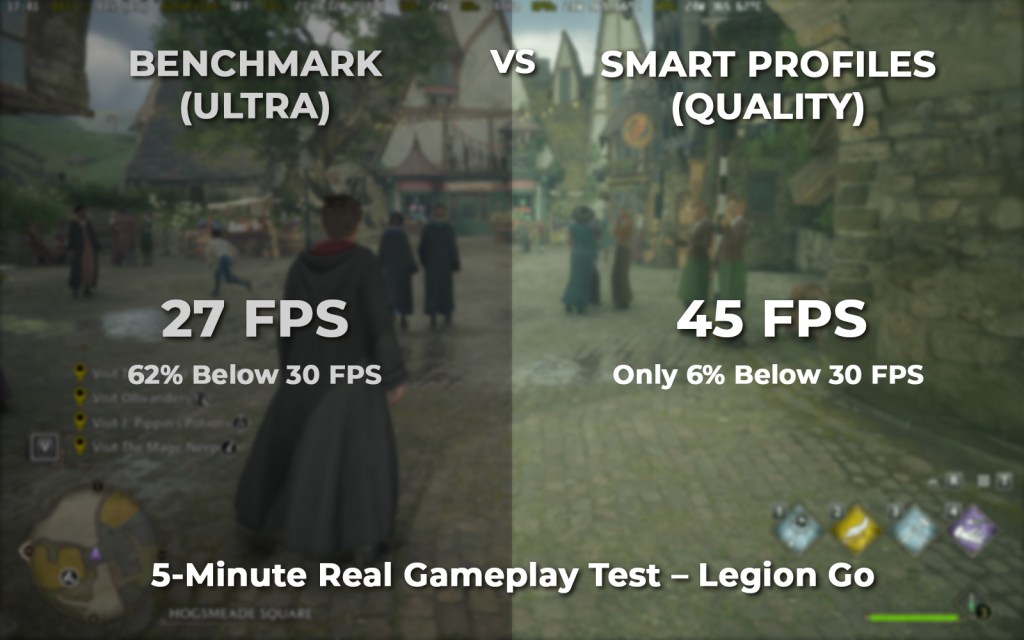
    Average FPS27.2345.01+65%
    1% Low FPS16.2225.37+56%
    0.1% Low FPS7.1215.07+111%
    Time Below 30 FPS62.56%5.97%-90%
    Severe Stutter (>50ms)5.91%0.24%-96%

    What These Numbers Actually Mean

    If you’re not used to performance metrics, here’s the simple version:

    • Average FPS tells you overall performance.
    • 1% Low FPS tells you how bad the dips get.
    • Time Below 30 FPS tells you how often the game feels unstable.
    • Severe stutter (>50ms) means noticeable hiccups or mini-freezes.

    With benchmark Ultra settings:

    • The game spent over 62% of the time below 30 FPS.
    • Severe stutters were far more frequent.
    • 0.1% lows dropped to around 7 FPS — that’s very noticeable.

    With Smart Profile (Quality):

    • Average FPS jumped to 45.
    • Time below 30 FPS dropped to under 6%.
    • Severe stutter was nearly eliminated.

    Same hardware.
    Same power.
    Same resolution.

    Completely different experience.


    Why Did the Game Recommend Ultra?

    Game benchmarks are usually designed with desktop PCs in mind.

    They don’t fully account for:

    • Power-limited handheld devices
    • Sustained thermal constraints
    • Shared memory bandwidth
    • Long gameplay sessions instead of short benchmark scenes

    Ultra settings might look impressive in a benchmark run.
    But over 5 minutes of real gameplay on a handheld, they struggle.


    Interesting Side Note: Different Device, Different Recommendation

    On another device — the ROG Xbox Ally X — the same benchmark recommended:

    Everything set to Low.

    So on one device (Legion Go), the benchmark suggests Ultra.
    On another device (Xbox Ally X), it suggests Low.

    That inconsistency highlights something important:

    The built-in benchmark isn’t truly optimizing for sustained handheld gameplay.
    It’s reacting to hardware detection, not real-world power-constrained scenarios.

    And in both cases, the recommendation doesn’t necessarily lead to the best experience.


    What This Means for Handheld Players

    This is especially important if you’re new to PC gaming.

    If you’re just getting into handheld PC gaming and the game recommends certain settings, it’s completely natural to think:

    “The game knows best.”

    Most people won’t question it.

    They’ll assume the recommended settings are optimized for their device.

    In this case, that assumption would lead to:

    • 62% of gameplay below 30 FPS
    • Frequent dips
    • Noticeable stutter
    • An experience that feels unstable

    And for someone new to PC gaming, that might create the impression that:

    • The device is weak
    • The game is poorly optimized
    • Or that handheld PC gaming just “isn’t smooth”

    When in reality, the issue isn’t the hardware — it’s the tuning.


    Why Smart Profiles Performed Better

    The Smart Profile (Quality) didn’t just lower everything blindly.

    It’s tuned specifically for:

    • Power-limited environments
    • Sustained performance
    • Frame pacing stability
    • Real gameplay conditions

    Even using the Quality profile (not Performance), it delivered:

    • 65% higher average FPS
    • 90% reduction in time spent below 30 FPS
    • 96% reduction in severe stutter

    That’s not a small tweak.

    That’s the difference between “playable but frustrating” and “smooth and enjoyable.”


    Final Thoughts

    Built-in benchmarks can be helpful — but they’re not always optimized for handheld gaming PCs.

    On the Legion Go, Hogwarts Legacy recommended Ultra.

    In real gameplay at fixed power, that resulted in heavy instability.

    The Smart Profile (Quality) delivered dramatically better stability under the same exact conditions.

    If you rely only on in-game recommendations, especially as a newcomer to PC gaming, you might not be getting the best experience your device is capable of.

    And in power-constrained handheld systems, tuning matters more than presets.


    If you want to set up ZenDeck and enable Smart Profiles, you can follow the full step-by-step guide here:
  • How to Install ZenDeck from Scratch and Use Smart Profiles (Beginner Friendly Guide)

    How to Install ZenDeck from Scratch and Use Smart Profiles (Beginner Friendly Guide)

    Intro

    If you’ve seen my recent Hogwarts Legacy comparison showing benchmark settings vs Smart Profiles, you might be wondering:

    How do I actually install ZenDeck and use it?

    This guide walks you through everything step-by-step — even if you’ve never used tools like this before.

    No technical knowledge required.


    What Is ZenDeck?

    ZenDeck is a lightweight performance manager and game launcher built specifically for Windows handheld gaming PCs like:

    • Lenovo Legion Go
    • ROG Ally
    • Other Windows handhelds (AMD based)

    It helps you:

    • Automatically apply optimized performance settings per game
    • Dynamically adjust TDP based on real gameplay conditions
    • Improve battery life without sacrificing stability
    • Make Windows sleep behavior more reliable during gaming
    • Eliminate constant manual tweaking

    Think of it as adding a “console-like” experience layer on top of Windows.


    Before You Start

    Before installing ZenDeck, make sure:

    • Your device is updated
    • You have administrator privileges
    • The game you want to use appears in the list of supported Smart Profiles

    ZenDeck will automatically notify you if a game needs to be launched once before Smart Profiles can be applied.


    Step 1 – Download ZenDeck

    1. Go to the official ZenDeck website
    2. Download the latest version
    3. Right-click the installer and select Run as Administrator
    4. Follow the installation steps

    The installer will handle everything for you. When it finishes, ZenDeck will open automatically.

    If Windows SmartScreen appears, click More Info → Run Anyway.


    Step 2 – First Launch

    When you open ZenDeck for the first time, it will automatically scan your installed games from:

    • Steam
    • Xbox PC (Game Pass)
    • Epic Games
    • Non-Steam games added to your system

    During this scan:

    • ZenDeck detects which games support Smart Profiles
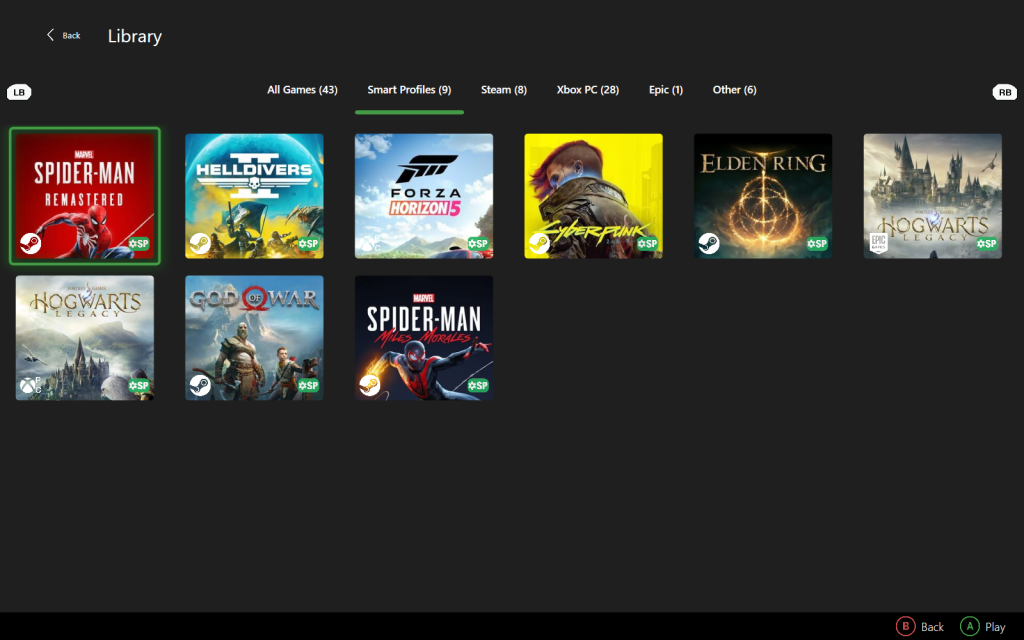
    • Supported games will be marked with an “SP” badge
    • You can also use the “Smart Profiles Ready” filter in the Library view to quickly see compatible titles
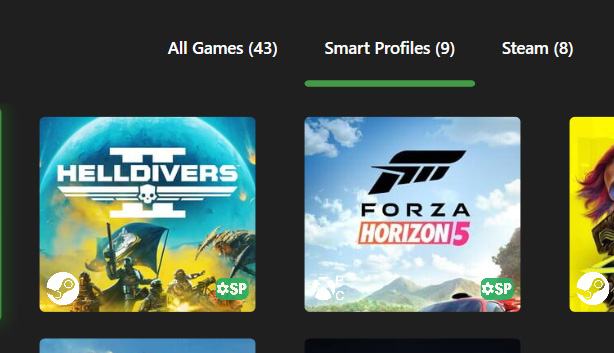
    ZenDeck library view showing supported games marked with the SP badge and the Smart Profiles Ready filter enabled.
    Games that support Smart Profiles are marked with the SP badge and can be filtered using “Smart Profiles Ready”.

    If a Game Needs to Be Initialized

    Some games need to be launched once before Smart Profiles can be applied.

    If ZenDeck shows a message saying the game must be run first:

    • Simply launch the game
    • Let it fully open
    • Then close it

    That’s it.

    After that, ZenDeck will be able to apply Smart Profiles automatically.


    Legion Go Users – One Important Setting

    If you are using a Lenovo Legion Go, Legion Go S or Legion Go 2, make sure to do this before using ZenDeck:

    1. Open the Legion Space side menu
    2. Go to Thermal Mode
    3. Set it to Custom

    The slider values do not matter.

    ZenDeck requires Thermal Mode to be set to Custom in order to control TDP properly.

    You only need to configure this once.

    This is a Lenovo firmware requirement, not a ZenDeck limitation.


    Step 3 – Using Smart Profiles

    Once a supported game appears with the SP badge, you’re ready.

    You have two ways to apply a Smart Profile:

    Option 1 – From the Library

    1. Open ZenDeck
    2. Use the “Smart Profiles Ready” filter
    3. Select your game
    4. When prompted, choose Apply Profile

    Option 2 – Simply Launch the Game

    If ZenDeck is already running, just launch the supported game.

    ZenDeck will detect it and prompt you to apply the Smart Profile.


    Once applied, ZenDeck will automatically:

    • Adjust resolution to the optimal preset
    • Configure GPU features according to the Smart Profile
    • Apply recommended performance tuning

    No manual tweaking required every time you play.


    Optional – Let ZenDeck Control TDP

    If you also want ZenDeck to manage power automatically, you need to enable it:

    1. Open Settings
    2. Go to ZenDeck section
    3. Enable “Allow ZenDeck to control TDP”
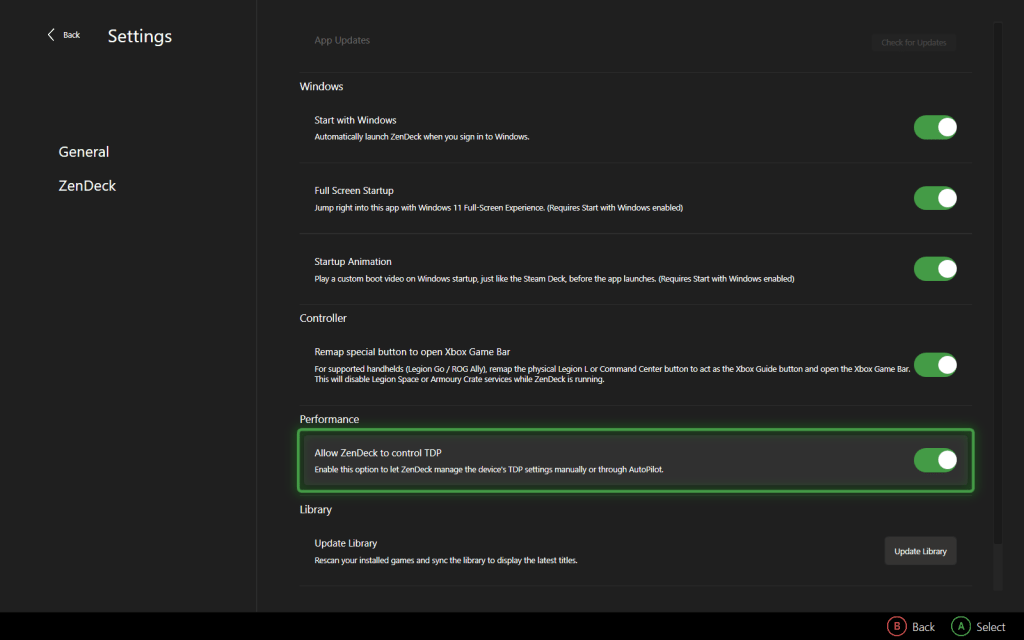
    ZenDeck settings screen showing the Allow ZenDeck to control TDP toggle enabled in the Performance section.
    Enable this option to allow ZenDeck to manage power manually or through AutoPilot Dynamic TDP.

    After enabling this, you can choose how TDP is managed:

    • Fixed power profiles (Silent, Balanced, Performance, Custom)
    • Or fully automatic control using AutoPilot Dynamic TDP

    Optional – Using ZenDeck Pulse (In-Game Control)

    ZenDeck Pulse is a widget inside the Xbox Game Bar that lets you manage performance while gaming.

    To enable it:

    1. Go to Settings → Controller
    2. Enable “Remap special button to open Xbox Game Bar”

    This will:

    • Disable Legion Space (Legion Go)
    • Disable Armoury Crate overlay (ROG Ally)
    • Remap to open Xbox Game Bar:
      • Legion L button (Legion Go)
      • Command Center button (ROG Ally)
      • View + Menu (Other handhelds without guide button)

    Now you can access the ZenDeck Pulse widget during gameplay.


    Inside ZenDeck Pulse you can:

    • Select AutoPilot Dynamic TDP from the Power Profile dropdown
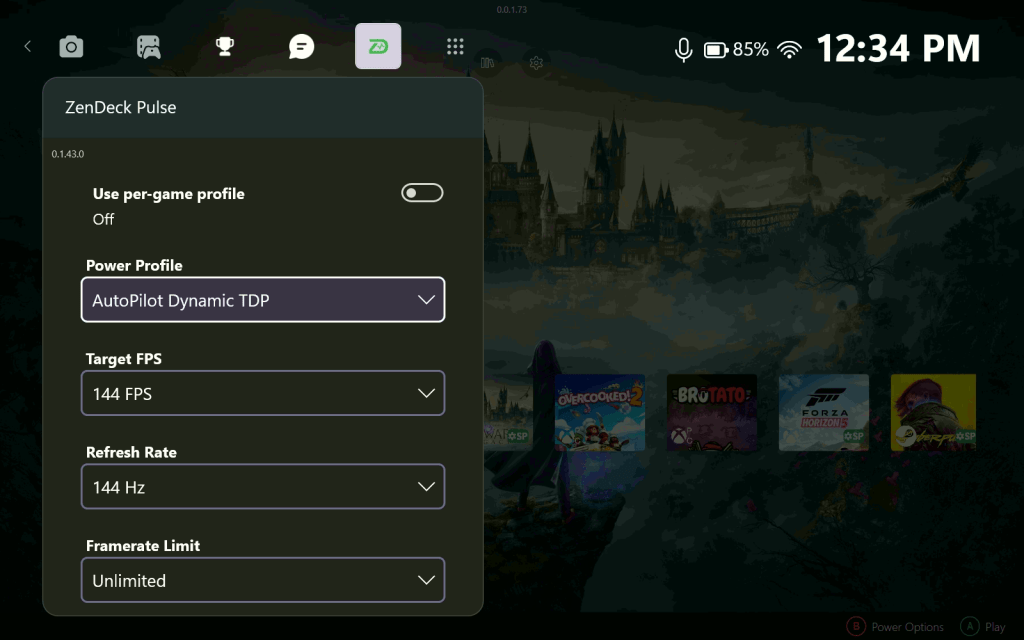
    ZenDeck Pulse widget inside Xbox Game Bar with AutoPilot Dynamic TDP selected as the active power profile.
    ZenDeck Pulse inside Xbox Game Bar with AutoPilot Dynamic TDP selected.
    • Change Refresh Rate
    • Adjust Resolution
    • Set Frame Limit
    • Enable FPS overlay

    When AutoPilot Dynamic TDP is selected, ZenDeck automatically adjusts power based on:

    • Game behavior
    • FPS stability
    • System conditions

    Real Example: Hogwarts Legacy

    In my recent Reddit post, I compared:

    • Benchmark-recommended settings
    vs
    • Smart Profiles automatically applied settings

    The result:

    • More stable frametimes
    • Better power efficiency
    • Smoother gameplay

    Smart Profiles focus on real-world stability, not just peak benchmark numbers.

    Want to see the real performance difference?

    I ran a controlled 5-minute gameplay test comparing:

    • Benchmark Ultra settings
    vs
    • Smart Profile (Quality)

    See the full performance breakdown here:

    Hogwarts Legacy: Benchmark Ultra vs Smart Profile – 5-Minute Real Gameplay Test

    You can watch the full comparison video and join the discussion here (300+ upvotes and counting):


    Do I Need to Reconfigure Every Time?

    No.

    Once a Smart Profile is enabled:

    ZenDeck remembers it.

    The next time you launch the game, everything is applied automatically.


    Common Questions

    Does this work with every game?

    Smart Profiles currently support selected games.
    More are being added over time.


    Is this safe?

    ZenDeck does not modify game files.
    It manages performance behavior externally.


    Why does my antivirus show a warning?

    Some antivirus programs may display a warning related to a driver called WinRing0.

    This driver is used to enable low-level power control (TDP adjustment) on certain devices.

    It is not malicious software.

    Some security tools flag it because it allows hardware-level access, which is commonly associated with system utilities.

    On Lenovo Legion Go (1/2/S), this driver is not used for TDP control.

    If you are unsure, you can always verify the file’s digital signature and download ZenDeck only from the official website.


    Final Thoughts

    Windows handhelds are powerful — but they require too much manual tuning.

    ZenDeck simplifies that.

    Instead of tweaking settings every time, you just play.

    If you haven’t tried Smart Profiles yet, this is the easiest way to start.


    Ready to Try It?

    Download the latest version of ZenDeck and try Smart Profiles in just a few minutes.

    Once configured, you won’t need to tweak settings every time you play.

    Download ZenDeck here:

    https://zendeck.app/